
Foam vs Rubber Gym Flooring: Which Is Better for a Home Gym?
Foam vs rubber gym flooring compared on compression, dropped weights, odor, weight and handling, cutting, grip, and the rooms each one suits.

In the foam vs rubber gym flooring decision, foam is the better fit if you want a light, cushioned floor for bodyweight work, stretching, and dumbbells, and rubber is the better fit if heavy equipment will stand on the floor, weights will come down hard, or you want a rubber surface under your shoes and plates. Between the two sits rubber-top foam: tiles with a rubber layer over a foam base. They change the surface you train on, but the base under the rubber is still foam.
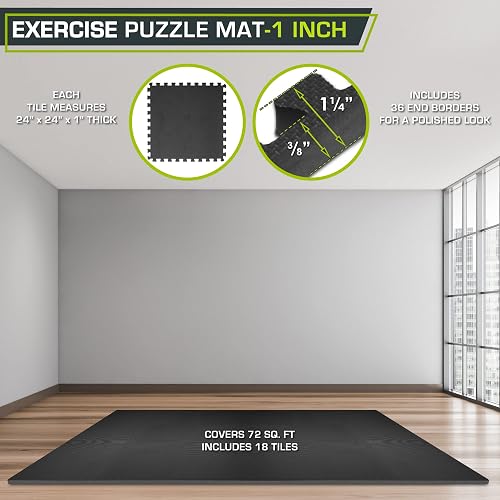
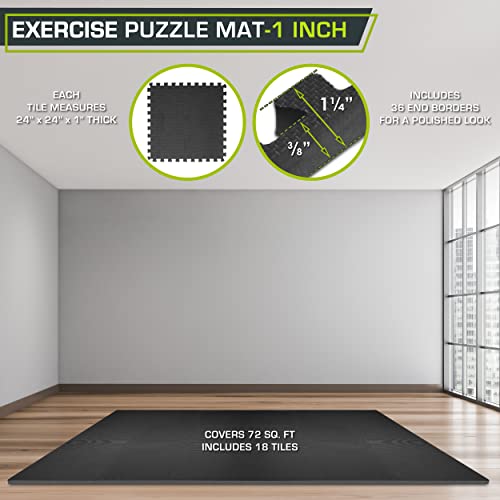
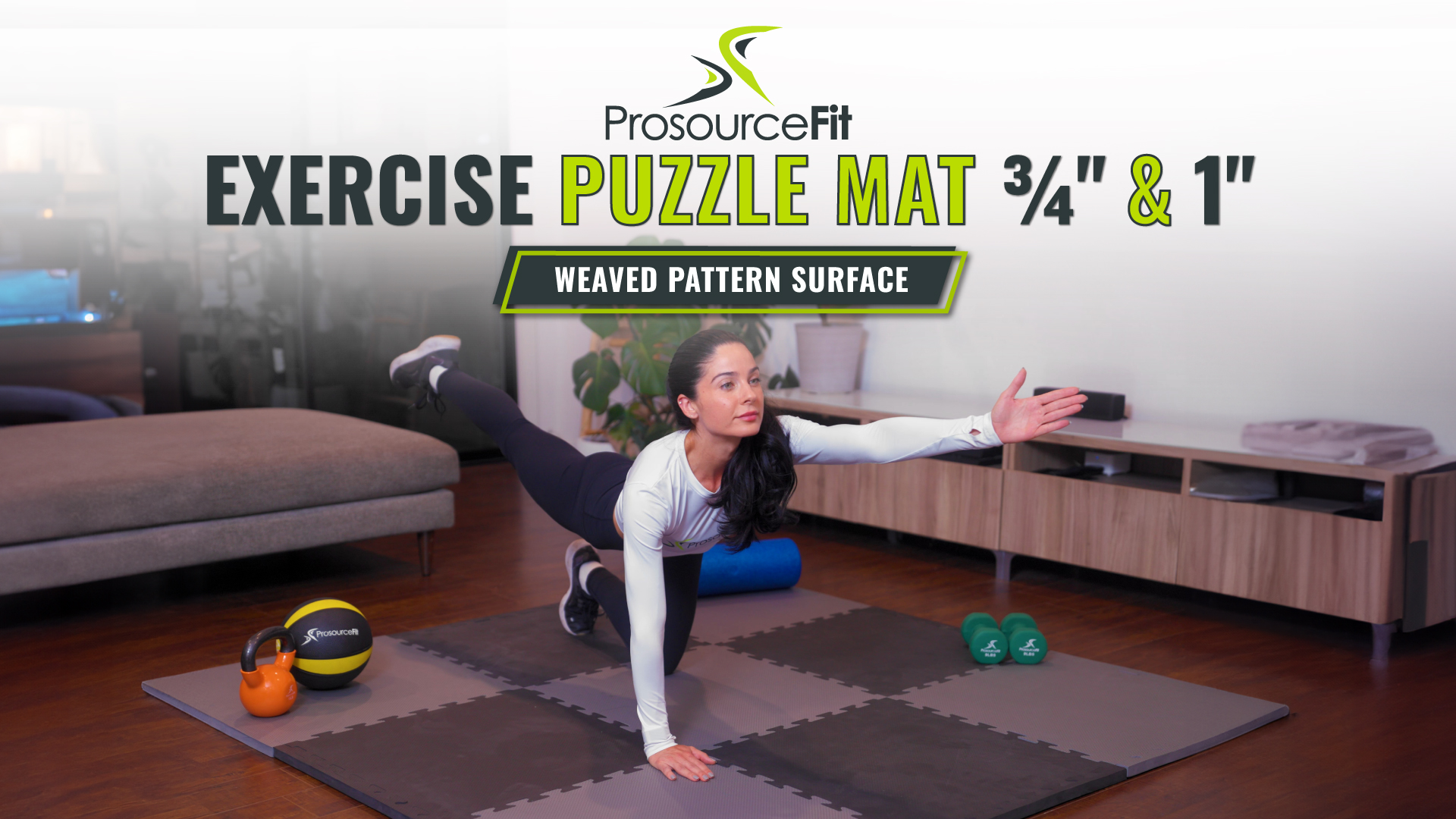
To keep the comparison concrete, we set two 1 in tiles of the same 24 x 24 in size side by side: the ProsourceFit Weaved Puzzle Mat (plain EVA foam) and the SUPERJARE 1 in rubber-top tiles (an EPDM rubber top over EVA foam). For solid rubber, which neither tile is, we use figures published by REP Fitness for its rubber floor tiles and by RitFit, a company that sells rubber flooring. Every product figure below comes from the Amazon listing or a maker page we opened; weights per square foot and room totals are our own arithmetic from those figures. The same questions apply to any rubber vs foam gym flooring choice.
This guide is general product information, not construction or engineering advice. If you are unsure whether a floor can carry heavy equipment, or you have a damp slab or an upstairs room, ask a qualified contractor before you lay flooring.
We earn a commission from qualifying purchases made through links on this page. Commissions never affect our rankings or StrengthRoomLab Scores.

ProsourceFit Weaved Puzzle Mat




As an Amazon Associate we earn from qualifying purchases.

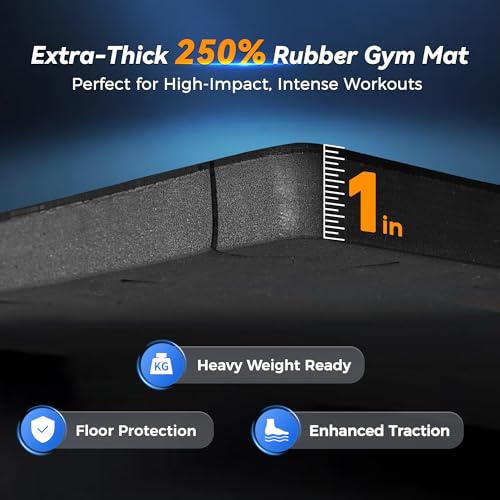
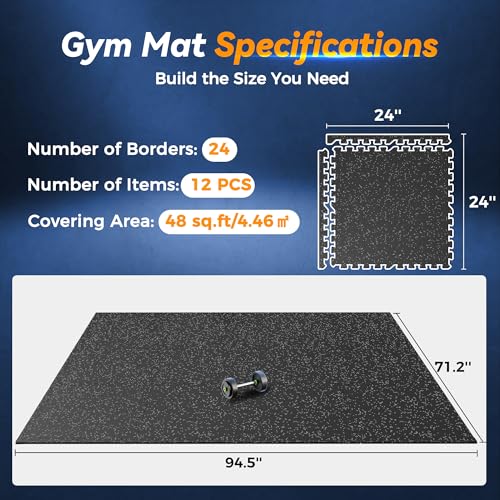
SUPERJARE Rubber-Top Tiles


As an Amazon Associate we earn from qualifying purchases.
Foam vs Rubber Gym Flooring: Side-by-Side
The source is noted in each cell. The third column is a reference point for solid rubber from REP’s own product page; it is not one of the two products above. “Not stated” means neither the listing nor a maker page we opened gives the figure.
| Spec | ProsourceFit Weaved Puzzle Mat 1 in (EVA foam) | SUPERJARE Rubber-Top Tiles 1 in (rubber over foam) | REP Rubber Floor Tiles (solid rubber reference) |
|---|---|---|---|
| Material | High-density EVA foam (listing; ProsourceFit) | EPDM rubber top over a high-density EVA foam base (listing) | Rubber (REP) |
| Tile size | 24 x 24 x 1 in (listing; ProsourceFit) | 24 x 24 x 1 in (listing) | 24 x 24 x 3/8 in (REP) |
| Coverage per box | 18 tiles, 72 sq ft (listing title); ProsourceFit also sells a 6-tile, 24 sq ft pack | 12 tiles, 48 sq ft (listing) | Set of four tiles, 16 sq ft (REP; our arithmetic at 4 sq ft per tile) |
| Weight | 8.7 lb for the 6-tile pack (ProsourceFit); the listing’s 2.24 kg item weight field conflicts with this | Not stated | 8 lb per tile (REP) |
| Surface | Non-skid textured surface (listing) | Matte, non-slip rubber surface (listing) | Smooth on both sides (REP) |
| Odor | Not mentioned in the listing | Listing calls the tiles odor-free | Low odor (REP) |
| Under heavy equipment | Listing says surface compression may occur with heavy equipment | Listing says the construction is tear-resistant and stands up to repeated impact | Durable enough to protect floors and equipment (REP) |
| Edges | End borders included (ProsourceFit) | Two detachable borders per tile (listing) | Puzzle border for adding tiles (REP) |
| Water | Water-resistant (listing); waterproof (ProsourceFit) | Not stated in this listing | Does not absorb moisture (REP) |
One listing quirk: the ProsourceFit listing’s title gives 18 tiles and 72 sq ft, while its description mentions six tiles and 96 sq ft, because the same text covers several pack sizes. ProsourceFit’s own store sells this 1 in mat as a 6-tile, 24 sq ft pack and an 18-tile, 72 sq ft pack. Count tiles from the pack you actually order.
What Each Material Actually Is
Plain foam tiles are a single material. The ProsourceFit listing describes high-density EVA foam with a textured top, and the same listing calls the tiles lightweight pieces that connect quickly and come apart just as fast.
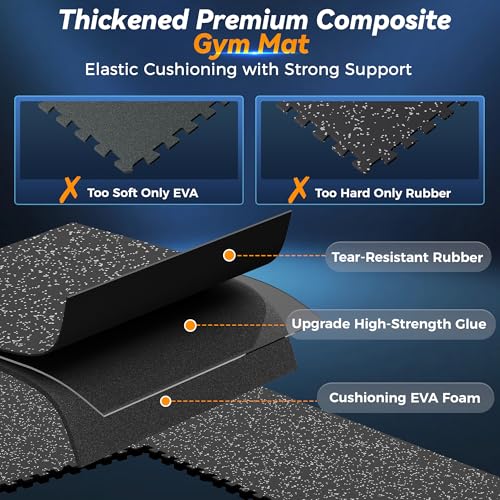
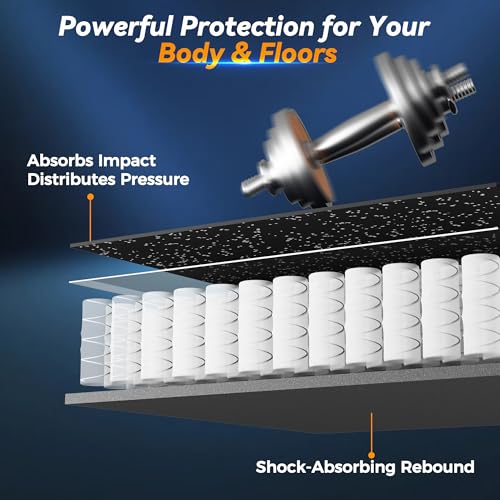
Rubber-top tiles are a sandwich. According to the Amazon listing, the SUPERJARE 1 in tile pairs a high-density EVA foam base with a strong EPDM rubber top. You stand and lift on rubber, but the cushion underneath is foam, so these tiles sit between the two materials rather than in the rubber camp.
Solid rubber flooring is rubber all the way through. RitFit’s rubber gym mat guide groups it into three formats: interlocking tiles, rolls, and horse stall mats. The same guide says recycled rubber mats are made from repurposed tire rubber and may give off an initial odor, while mats made from new (virgin) rubber have a more uniform look and lower initial odor. RitFit sells rubber flooring, so read its guidance as a seller’s view.
Firmness and Compression Under Equipment
This is the clearest difference between the materials. The ProsourceFit listing says plainly that surface compression may occur with heavy equipment, even at 1 in thick. ProsourceFit’s product page for the 1 in mat still calls it the choice it recommends for intense workouts, large gyms, and heavy traffic, and says the foam can withstand heavy exercise equipment. Both statements can be true: the tile protects the floor below, and the foam can show marks where rack feet or bench legs press down.
Solid rubber sellers describe the opposite trade. REP’s rubber floor tiles page says its 3/8 in tiles are durable enough to protect your floors and equipment, and RitFit’s page for its rubber tiles claims they stand up to heavy weights without bending or denting and outlast foam. Neither page gives a load figure for those claims, and both companies sell rubber, so treat them as maker claims. The SUPERJARE rubber-top listing says its construction stands up to intense pressure, but it gives no load figure either, and the layer under its rubber top is foam.
In practice: if a loaded bench, a power rack, or a cable machine will stand in one spot for years, the foam listing’s compression warning is the line to weigh, and solid rubber, or a plywood board under the feet on foam, is the cautious choice. If the floor mainly holds you, a yoga mat, and a pair of dumbbells, compression matters much less, and foam’s cushioning is the point.
Dropped Weights
None of the three products in the table comes with a published drop height or load figure. The SUPERJARE 1 in listing names heavy weight drops and dropping loaded barbells among its uses, and ProsourceFit describes its 1 in foam as built for high impact. Without numbers, those lines do not tell you what happens when a loaded barbell comes down from hip height on a slab.
The only published guideline we found is for rubber: RitFit’s guide calls 3/4 in rubber the recommended minimum for training that involves dropping weights from hip height or higher. No foam source we opened gives an equivalent figure. If drops are part of your training, plan for solid rubber or a lifting platform in that zone, and size it by how thick each zone should be rather than by one number for the whole room.
Odor
Odor is mostly a rubber question. The ProsourceFit listing does not mention smell either way. The SUPERJARE 1 in listing calls its tiles odor-free, while a thinner SUPERJARE rubber-top listing describes an upgrade with less rubber odor, which suggests some smell is possible with that version. REP describes its solid rubber tiles as low odor.
For recycled rubber, RitFit’s guide is specific: it suggests unpacking new mats outdoors or in a well-ventilated space for 24 to 72 hours before installing them, and it says horse stall mats have a stronger initial smell that may take one to two weeks to fade. In a spare bedroom or a basement with little airflow, that is a real difference. Ask about return terms before you open every box, and air the flooring out somewhere other than the room you will train in.
Weight, Handling, and Cutting
Rubber is heavy, and the gap is large. ProsourceFit lists its 6-tile pack of 1 in foam tiles, 24 sq ft in all, at 8.7 lb. REP lists a single 3/8 in rubber tile, 4 sq ft, at 8 lb. By our arithmetic that is about 0.36 lb per square foot for the foam against 2 lb per square foot for the rubber, so the rubber floor weighs more than five times as much per square foot while being well under half as thick. For an 8 x 10 ft training zone (80 sq ft), that works out to roughly 29 lb of the 1 in foam against 160 lb of the 3/8 in rubber tiles.
Larger rubber pieces are heavier still. RitFit’s guide says a 4 x 6 ft horse stall mat weighs approximately 100 lb and takes two people to install and reposition, and that rolls can weigh 100 to 200 lb per piece. If the gym is in a basement or up a flight of stairs, that matters as much as anything else in this comparison. The SUPERJARE listing gives no weight for its rubber-top tiles, so check the shipping weight before you plan a carry down the stairs.
Cutting follows the same pattern. For rubber, RitFit’s guide says to score the surface firmly three or four times along a measured line with a utility knife and a T-square, then flex the mat to finish the cut, using a fresh blade and cut-resistant gloves. None of the foam listings we read describes a cutting method, so check with the seller before you trim foam tiles around a door frame. Both tile types come with border pieces, which handle the outside edge without cutting. Installing rubber flooring well also involves layout and seams, which deserve their own step-by-step.
Surface, Grip, and Moisture
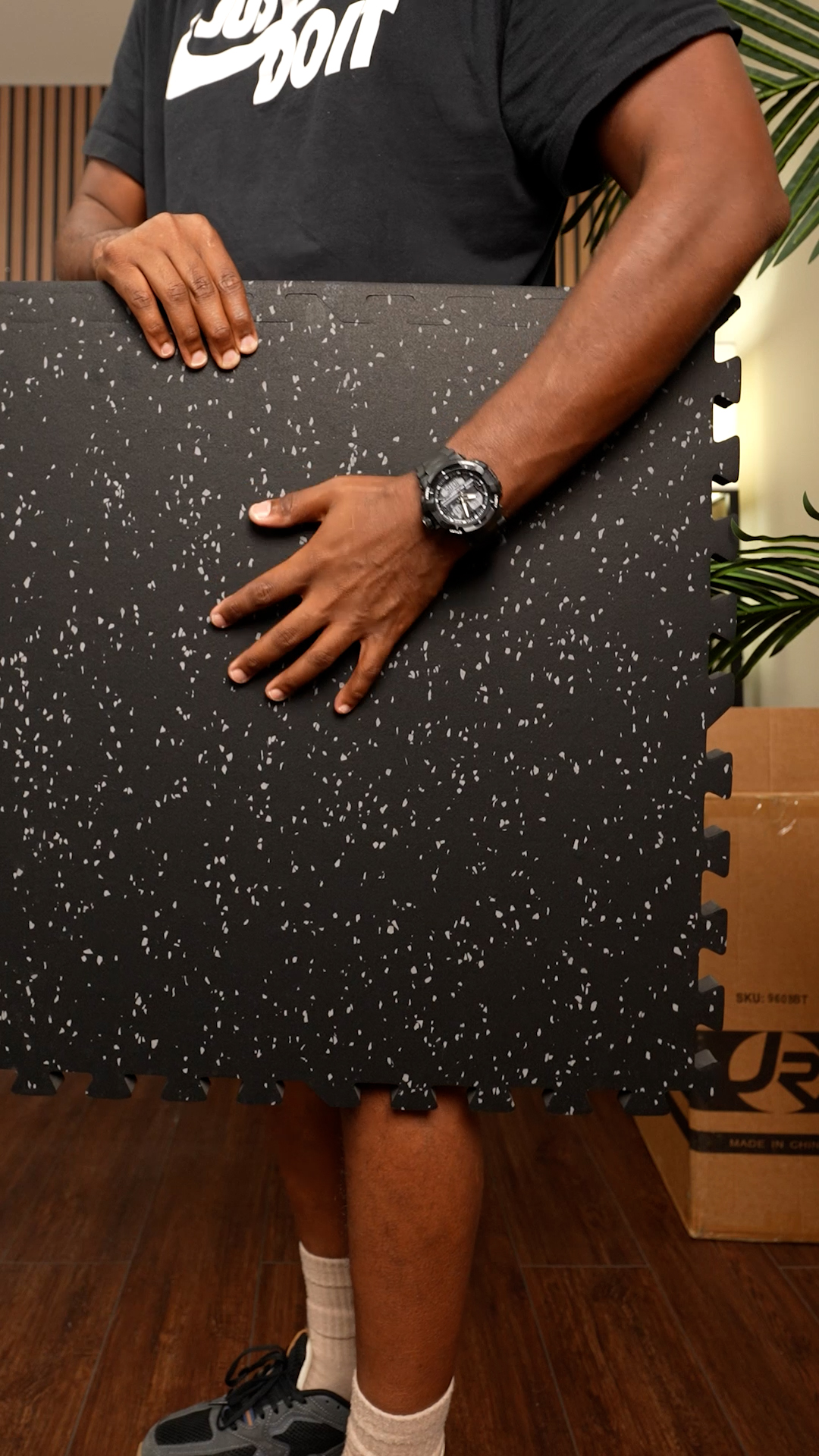
The foam tile’s surface is textured: the ProsourceFit listing describes a non-skid texture that provides traction. The SUPERJARE listing describes a matte, non-slip rubber surface and pitches it at squats and deadlifts. REP’s solid rubber is smooth on both sides. Which surface suits you depends on the work. ProsourceFit’s listing for the 1/2 in version of its puzzle mat describes a soft surface for push-ups, crunches, and yoga, while the SUPERJARE listing aims its rubber top at heavier lifting.
On water, the ProsourceFit listing says water-resistant and ProsourceFit’s page says waterproof; REP says its rubber does not absorb moisture. None of those statements covers moisture rising through a concrete slab under the tiles, so lift a tile now and then in a basement or garage. Day-to-day care differs too: ProsourceFit’s page says to wash its foam with warm water and soap and a soft cloth, and cleaning a rubber gym floor has its own rules on which products to avoid.
Garages, Basements, and Upstairs Rooms
Both tiles are sold for these rooms: ProsourceFit names basements and garages, and the SUPERJARE listing names a garage, a gym, and a basement. Neither listing, and neither REP nor RitFit on the pages we opened, gives a temperature range for use or storage. If your garage swings from hot summers to freezing winters, lay one box first and watch the seams across a change of season before you cover the whole zone. Choosing flooring for a garage gym has more questions than material alone, such as vehicle traffic and the line of the garage door.
Upstairs, noise is the question. The ProsourceFit and SUPERJARE listings both describe their tiles as reducing noise, and REP says its rubber reduces noise while you lift. None of them gives a figure, so no flooring choice here should be read as soundproofing. In an apartment, the safer plan is to avoid drops altogether, whichever material you choose.
Which Should You Buy?
- Choose foam if the floor is mostly for bodyweight work, stretching, dumbbells, and light equipment, you want to carry and lay it yourself, or you rent and may need to pack the floor up. The ProsourceFit Weaved Puzzle Mat gives 1 in of high-density EVA foam per tile, according to the Amazon listing.
- Choose rubber-top foam if you want a rubber surface for lifting but still want interlocking tiles with a foam cushion underneath. The SUPERJARE Rubber-Top Tiles 1 Inch put an EPDM rubber top over EVA foam, per the listing.
- Choose solid rubber if a rack or heavy machine will stand on the floor for good, or weights will be dropped. Expect far more weight to move and, with recycled rubber, an airing-out period before the room smells normal.
- You should look elsewhere if you plan repeated heavy barbell drops on either tile above, since neither listing backs its impact claims with a drop height, or if you need a floor with a published temperature range for an unheated garage.
How We Compared These
We do not conduct our own product trials; our picks draw on published specifications, independent reviews, and Amazon owner ratings, which also set each product’s StrengthRoomLab Score. For this comparison we read both Amazon listings in full, checked the foam tile against ProsourceFit’s product page, and used REP’s and RitFit’s own pages for solid rubber figures, noting that both companies sell rubber flooring. Where a listing contradicts itself, we say so. Commissions never affect which products we cover or how we score them. The full method is on our How We Review page.
FAQ
Is rubber or foam better for a home gym floor?
It depends on what the floor carries. Foam suits floor work, dumbbells, and light equipment, and it is easy to move. Rubber suits heavy equipment and dropped weights, and it is much heavier to handle. A home gym can also mix materials by zone rather than use one for the whole room.
Is rubber-top foam the same as rubber gym flooring?
No. A rubber-top tile such as the SUPERJARE 1 in has an EPDM rubber surface over an EVA foam base, according to the Amazon listing, so the base under the rubber is foam. Solid rubber tiles, rolls, and stall mats are rubber all the way through, and REP lists a single 3/8 in rubber tile at 8 lb.
Which is easier to cut, foam or rubber gym flooring?
RitFit’s guide describes cutting rubber with a utility knife and a T-square: score the line three or four times, then flex the mat, with a fresh blade and cut-resistant gloves. The foam listings we read do not describe a cutting method, so ask the seller first. With either material, measure twice and use the included border pieces for outside edges.
Which is quieter, foam or rubber gym flooring?
Both are sold as noise-reducing. The ProsourceFit and SUPERJARE listings describe their tiles that way, and REP says its rubber reduces noise while you lift, but none of them publishes a figure. Treat any of them as a way to soften footsteps and set-downs, not as soundproofing for the room below.
Can you use foam and rubber flooring in the same home gym?
Yes. One layout puts foam under the stretching and bodyweight area and rubber under the rack or the lifting area. The catch is the edge where the two meet: the 1 in foam and rubber-top tiles above share the same height, but 3/8 in solid rubber tiles sit lower, so keep that step away from where you walk backward or carry weights.
Final Verdict
Choose by what stands on the floor, what falls on it, and how far you have to carry it. Foam is the light, comfortable option for floor work and dumbbells, with the trade of compression under heavy feet. Rubber-top foam gives you a rubber surface over a foam cushion. Solid rubber is the heavy option for racks and drops, with an airing-out period for recycled rubber. If you want to compare more tiles in each material, the best home gym flooring for you is the one whose material matches each zone of your room. Browse our gym flooring category for more floors we have researched.
About the author
Sean Freeman has maintained a home fitness routine for five years, combining daily walking, recreational running, and resistance band and mobility exercises. Over the past two years, Sean has researched and written about compact fitness equipment, focusing on storage, ease of use, and suitability for smaller living spaces. Sean covers walking pads, gym flooring, and resistance bands, helping readers build practical spaces for everyday exercise.